
How Artificial Intelligence Could Reshape the Organizational Architecture of the Single-Family Office
By Frederic J Methlow
Abstract
The discussion of artificial intelligence in family offices has concentrated predominantly on operational efficiency: faster manager research, automated reporting, improved due diligence and more efficient data processing. This article argues that this perspective may underestimate AI’s ultimate impact. A sufficiently sophisticated agentic investment platform could alter the organizational logic of the single-family office (SFO) itself.
The traditional investment office is fundamentally an information-processing hierarchy. Analysts gather information, senior professionals interpret it, the chief investment officer (CIO) synthesizes their conclusions, and the board exercises periodic oversight through information largely selected and structured by management. AI potentially collapses this hierarchy. Specialist AI agents can perform parallel investment functions; an orchestration layer can integrate their findings; and board members can interrogate the underlying investment information directly. Continuous monitoring can meanwhile replace much periodic reporting with event-driven governance.
Such an architecture challenges the traditional CIO’s role as the principal informational intermediary between portfolio and board. It simultaneously creates a new governance requirement: independent stewardship of the information universe upon which AI recommendations depend. This article calls this emerging function the Content Gater or Information Steward.
The result is not necessarily a human-free family office. Rather, it is a family office in which human comparative advantage migrates from information processing toward governance, judgment, information integrity and accountability.
1. AI May Change the Organization, Not Just Its Productivity
Artificial intelligence has become a significant subject for family offices. Current industry analysis focuses on applications including portfolio reporting, document processing, due diligence, investment research, risk analysis and administrative automation. Citi has described the emergence of the “intelligent, automated family office,” while emphasizing the particular privacy and institutional-governance challenges associated with family-office data. [1] PwC similarly identifies investment decisions, due diligence, risk management and operations as areas being reshaped by AI. [2] Most discussion nevertheless assumes that AI enters an essentially unchanged organization:
Traditional family office + AI = more efficient traditional family office.
This article considers a different possibility.
If AI progresses from productivity software toward integrated agentic investment systems, the technology may eliminate some of the informational constraints that originally produced the traditional family-office hierarchy.
The relevant question then becomes not:
How can AI make the investment team more productive?
but:
If machines increasingly perform the information-processing functions around which the investment team was organized, why should the existing organizational structure remain unchanged?
This distinction is particularly relevant to SFOs whose investment activity consists substantially of asset allocation, external-manager selection and portfolio oversight rather than direct security selection.
A conventional SFO investment organization might resemble:
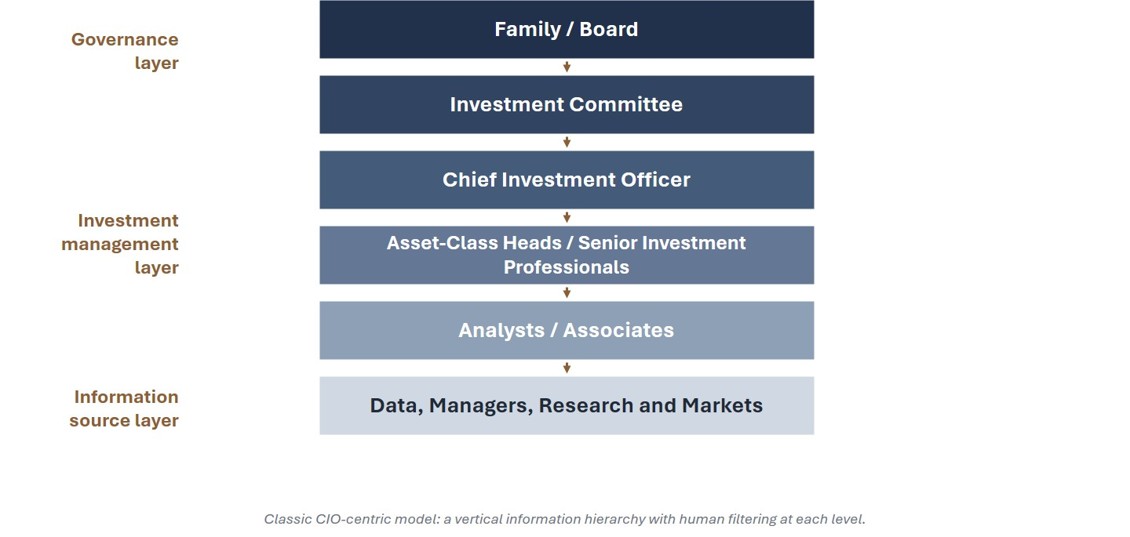
This hierarchy exists partly because human attention is scarce. Analysts divide an enormous information universe into manageable components. Senior investment professionals interpret their work. The CIO integrates the conclusions and presents a compressed representation to the board.
AI potentially attacks that constraint.
2. The Investment Office as an Information-Processing System
The conventional investment hierarchy can be understood as a mechanism for progressively compressing information.
At the bottom sit manager reports, portfolio holdings, market data, academic research, consultant reports, due-diligence questionnaires, meeting notes and countless other information sources. Analysts transform these materials into research. Senior investment professionals select what matters. The CIO combines those specialized views into portfolio recommendations. The investment committee or board receives the final synthesis.
This architecture is efficient when human beings are the primary processors of information. But it inevitably creates information asymmetry.
Board members cannot independently read every manager document, attend every meeting or reconstruct every historical investment decision. They therefore rely on the CIO not merely for recommendations but also for the information required to evaluate those recommendations. The CIO consequently occupies a uniquely powerful position: investment decision-maker, information synthesizer and information intermediary. AI potentially separates these functions. A board equipped with direct access to the SFO’s institutional intelligence could ask independently:
Why are we still invested with Manager X?
What has changed since the original investment thesis?
Compare today’s portfolio with the one presented during initial due diligence.
Which concerns expressed by our investment team over the last five years subsequently proved justified?
Which alternative managers have we rejected, and would any now represent superior replacements?
These questions could be answered from the underlying institutional record rather than solely through a new memorandum prepared by the investment team.
That is not simply better reporting. It is a redistribution of information within the organization.
3. From AI Assistant to Agentic Investment Office
This possibility becomes more credible with the development of agentic AI.
An AI agent is more than a conversational interface. It can receive an objective, access defined information and analytical tools, perform a sequence of tasks and communicate its conclusions to other agents or humans.
An investment platform can therefore divide work among artificial specialists. Consider an SFO evaluating whether to redeem an external manager.
A Manager Research Agent examines personnel, portfolio changes, DDQs, meeting transcripts and manager communications.
- A Quantitative Agent evaluates returns, factor exposures, concentration, drawdowns and performance persistence.
- A Portfolio Agent calculates the consequences of redemption for the overall portfolio.
- A Liquidity Agent examines redemption restrictions and future cash requirements.
- A Replacement Agent compares alternative managers.
- A Risk Agent evaluates downside scenarios.
- A Critic Agent identifies weaknesses in the emerging conclusion.
- A Devil’s Advocate Agent constructs the strongest argument against the majority recommendation.
- An Orchestrator Agent then synthesizes the analyses.
This is no longer simply AI helping an analyst write a report. It computationally reproduces an important feature of the investment organization itself: specialized division of analytical labour.
A significant example appeared in 2026 with Andrew Ang, Nazym Azimbayev and Andrey Kim’s The Self-Driving Portfolio: Agentic Architecture for Institutional Asset Management. Their architecture uses approximately 50 specialized agents to generate capital-market assumptions, construct portfolios using numerous methodologies, critique competing outputs and aggregate conclusions. A meta-agent evaluates previous forecasts against realized outcomes. [3]
The organizational analogy is striking.
The traditional investment office consists of:
human specialists coordinated by a human CIO.
An agentic platform consists of:
AI specialists coordinated by an AI orchestrator.
Once that distinction is recognized, the possibility arises that the AI platform is not simply a tool used by the investment office.
Increasingly, it may constitute the analytical investment office itself.
4. Does the CIO Retain an Informational Advantage?
The CIO will clearly not disappear merely because an AI can summarize manager reports.
The more difficult question arises when the platform acquires informational breadth that no individual CIO can realistically reproduce.
A mature SFO intelligence system could contain every investment memorandum, manager meeting transcript, quarterly report, DDQ, portfolio position, historical recommendation, board decision and relevant research document accumulated by the office.
It could combine this proprietary institutional memory with market data, external research, academic literature and portfolio analytics. No human CIO can simultaneously retain and interrogate an information universe of comparable breadth.
Suppose the CIO recommends increasing an allocation to Manager A.
The board could instruct the platform:
Evaluate this recommendation independently. Compare it with everything we have learned about Manager A since initial due diligence, our experience with comparable managers, current portfolio exposures, liquidity requirements and all credible alternatives in our manager database. Construct the strongest case against the CIO’s recommendation.
It could then ask:
Identify previous occasions on which the CIO made comparable recommendations and evaluate the subsequent outcomes.
Eventually:
Does our CIO exhibit systematic biases in manager selection or termination?
The platform can maintain a decision ledger recording information available at the time, recommendations made, reasoning, board decisions and subsequent outcomes. This allows the board to distinguish investment outcomes from decision quality and potentially compare actual decisions with AI-generated counterfactuals. The CIO therefore becomes subject to a new question:
What incremental value does human CIO judgment add to the analytical capability already available to the board?
The answer may remain substantial. Relationships, negotiation, intuition, assessment of character and judgment under unprecedented circumstances remain difficult to automate.
But these functions need not necessarily remain bundled within a CIO position.
AI does not have to outperform the CIO at every component of the job. It merely has to unbundle enough of the CIO’s traditional functions that maintaining the complete position becomes less economically compelling.
5. From Periodic Oversight to Continuous Governance
The implications extend beyond the CIO. Traditional investment governance operates according to a calendar. Investment committees meet monthly or quarterly. Reports are prepared beforehand. Managers and portfolio exposures are reviewed periodically. This structure is partly a consequence of human monitoring limitations.
An AI system does not require quarterly intervals. It can monitor manager personnel, portfolio exposures, liquidity, performance, risk limits and other relevant variables continuously. Governance can consequently become event-driven rather than calendar-driven.
Suppose a manager loses two senior investment professionals while portfolio concentration increases and factor exposures move materially outside their historical range. Instead of waiting for the next quarterly meeting, the system could approach the board:
Material event detected: Manager A
Organizational deterioration combined with potential style drift.
Recommended action: Suspend additional allocations and initiate formal review.
Alternative: Reduce position by 50%.
Board action required: Yes.
The architecture becomes:
Observe → Detect → Analyse → Recommend → Escalate → Decide → Learn
This does not imply bombarding directors with continuous notifications. The opposite should occur. The platform monitors continuously while the board operates by exception.
Routine matters remain within predetermined parameters. Informational developments are recorded without requiring action. Material developments trigger alerts. Strategic decisions require explicit board authorization.
Continuous monitoring can therefore reduce rather than increase the board’s informational burden. The quarterly investment meeting consequently changes purpose.
Instead of being the principal mechanism through which directors discover what happened during the previous three months, it increasingly becomes a forum for meta-governance:
- How well did the system perform?
- Which recommendations were overridden?
- Where was it wrong?
- Are escalation thresholds appropriate?
- Which sources have proved unreliable?
- Has the family’s risk tolerance changed?
- Is the system still optimizing for the objectives the family actually wants?
The board increasingly governs the investment intelligence system, rather than processing the portfolio itself.
6. A Different Kind of Board
This model requires a different conception of board competence.
Historically, investment committees benefited from members possessing substantial accumulated financial knowledge because interpreting investment information required specialist expertise.
AI potentially reduces the value of possessing information while increasing the value of interrogating information intelligently.
A director could ask:
Explain this recommendation without technical terminology.
What assumptions would have to be wrong for this decision to fail?
Why does your recommendation differ from the investment team’s recommendation?
Argue against your own conclusion.
Which information are we missing?
What are the five questions I should ask before approving this investment?
The crucial board capability becomes less the memorization of financial knowledge than the ability to formulate questions, understand uncertainty, identify unstated assumptions and exercise judgment where competing objectives cannot be resolved algorithmically.
The automated SFO therefore does not imply a passive board.
It requires a more active and technologically capable board.
Indeed, if the investment office becomes increasingly automated while the board retains traditional quarterly practices, the governance layer itself becomes the new organizational bottleneck.
7. The New Critical Function: The Content Gater
Direct board access to AI creates a new problem.
AI recommendations depend on the information available to the system.
The decisive governance question is therefore not merely:
How intelligent is the AI?
It is also:
What does the AI know, what does it not know, and who determined that?
Imagine an AI evaluating whether an SFO should increase its allocation to private equity.
A system populated heavily with private-equity manager materials and investment-bank research may produce different conclusions from one that also contains independent research on persistence, fee drag, liquidity, survivorship bias and public-market-equivalent performance.
Similarly, an AI may develop an implicit incumbency bias if it possesses exhaustive information on existing managers but superficial information on potential replacements.
The information architecture therefore shapes the decision architecture.
This creates a new professional function: the Content Gater, or more formally, the Information Steward.
The role is not primarily to make investment decisions.
It is to govern the epistemic environment in which those decisions are generated.
Responsibilities could include:
- determining which external research enters the platform;
- ensuring competing investment perspectives are represented;
- maintaining source provenance;
- assessing data reliability;
- incorporating manager documents and meeting transcripts;
- identifying stale information;
- governing access by different AI agents;
- ensuring contradictory evidence is preserved rather than filtered out;
- monitoring information gaps;
- and maintaining the integrity of the SFO’s institutional memory.
This person could become one of the most consequential professionals in the AI-native family office. In the traditional SFO, organizational power partly resides with the person who interprets information. In the AI-native SFO, power may migrate upstream toward whoever governs what information is available for interpretation.
8. Why the Content Gater Should Report to the Board
The reporting line is critical.
If the Content Gater reports to the CIO, the board’s supposedly independent AI system risks becoming circular:
CIO → controls information environment → AI evaluates CIO → Board
The individual being monitored would influence the information available to the monitoring system.
The Content Gater should therefore have an independent reporting line to the board.
A possible architecture is:
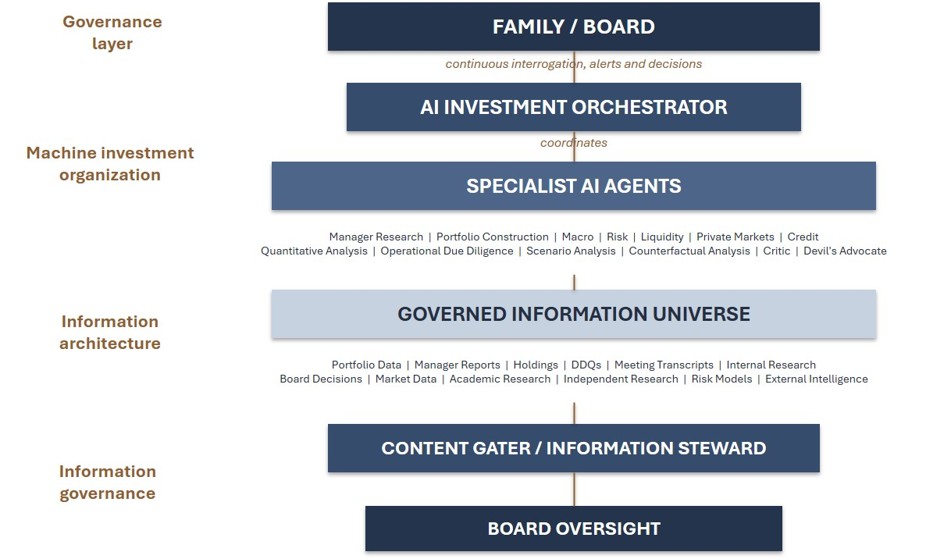
The board should approve the principles governing source selection, provenance, information diversity, access, retention and auditability.
The Content Gater administers the information architecture but should not possess unlimited discretion over it. This introduces a new principal-agent problem. If the CIO’s information monopoly diminishes, the Information Steward could become a new gatekeeper. The appropriate solution is not to eliminate the role but to make its decisions transparent and auditable.
9. The Most Dangerous Information May Be the Information That Is Missing
AI governance must distinguish between incorrect information and missing information.
A sophisticated system can reason correctly from incomplete evidence and still produce a poor recommendation. This failure may be especially dangerous because the resulting answer can appear highly rigorous. Board-level recommendations should therefore disclose not only their evidence but their informational limitations.
A material recommendation might contain:
- Recommendation
- Confidence level
- Principal supporting evidence
- Contradictory evidence
- Material information gaps
- Unavailable or excluded sources
- Alternative interpretation
- Conditions that would reverse the recommendation
Such disclosure makes the platform’s epistemic boundaries visible.
The board should not merely ask:
Why do you believe this?
It should routinely ask:
What potentially relevant information do you not possess?
This may become one of the central disciplines of AI-era investment governance.
10. From CIO-Centric to Governance-Centric Family Office
The organizational transition can now be summarized:
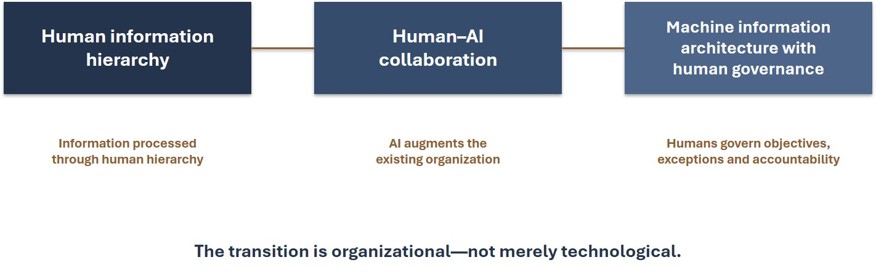
The traditional SFO is CIO-centric.
Information flows upward through analysts and investment professionals. The CIO synthesizes it. The investment committee receives the synthesis. Institutional expertise resides primarily in people.
The AI-native SFO becomes governance-centric.
The platform becomes the central information-processing architecture. Specialist agents analyse different aspects of the portfolio. The board accesses the intelligence layer directly. Material developments are escalated continuously. The Content Gater protects the integrity of the information universe.
Humans remain essential, but their comparative advantage changes.
- They define objectives.
- They judge exceptional circumstances.
- They assess people and relationships.
- They negotiate.
- They resolve conflicts among financial, family and ethical objectives.
- They govern the machine.
- And ultimately, they remain accountable.
The investment organization can consequently become much smaller without necessarily becoming less sophisticated.
11. Implications for the Family-Office Industry
If this model develops, several established assumptions about family-office scale may weaken.
Historically, greater wealth and complexity justified larger investment teams because institutional capability required institutional staffing. AI reduces the marginal cost of analytical breadth. A relatively small SFO could potentially possess research and monitoring capabilities previously requiring dozens of professionals.
Competitive advantage may therefore migrate from headcount to architecture.
The distinction between large and small investment teams becomes less important than the distinction between high-quality and low-quality information systems. Recruitment changes accordingly.
Demand for junior professionals performing repetitive information processing may decline, while demand rises for information stewards, AI architects, model-risk specialists and investment professionals capable of critically supervising machine intelligence.
Institutional memory also becomes more durable. Family offices frequently lose substantial knowledge when investment professionals leave. An integrated AI system can preserve historical investment theses, meeting transcripts, board decisions and subsequent outcomes.
Knowledge becomes an institutional asset rather than primarily a personal one.
12. Conclusion
Artificial intelligence may ultimately have a much more consequential effect on family offices than improving research productivity.
The traditional investment organization developed around a fundamental constraint: human capacity to acquire, process and synthesize information is limited.
Hierarchy solved that problem.
Analysts collected information.
Senior professionals interpreted it.
The CIO synthesized it.
The board received a compressed representation.
Agentic AI challenges the underlying constraint.
A sufficiently sophisticated investment platform can potentially maintain broader institutional memory than any CIO, conduct multiple analyses simultaneously, monitor continuously and provide recommendations directly to the board.
The question therefore changes. It is no longer simply whether AI makes the CIO more effective. It becomes:
Does the organizational logic that created the traditional CIO-centered family office continue to exist when machine intelligence becomes the principal processor of investment information?
The answer will depend upon the development of AI, the nature of the family’s investments and the continued value of human judgment. But even partial movement in this direction has significant consequences. The board becomes an active interrogator rather than a periodic recipient of management information. Governance becomes increasingly event-driven. The CIO loses part of the informational monopoly traditionally associated with the position. And the integrity of the information universe itself becomes a board-level concern, creating the need for an independent Content Gater or Information Steward. The future family office is therefore unlikely to be simply today’s organization with fewer analysts. It could represent a fundamentally different allocation of functions:
machines process information; humans govern intelligence.
AI may consequently bring about not the end of the family office, but the end of the family office as an organization built around human information processing. The scarce resources of the AI-native SFO will no longer primarily be information or analytical capacity.
They will be information integrity, judgment and accountability.
And that may ultimately divide the industry not between large and small family offices, but between legacy family offices and AI-native ones.
[1] AI in the Family Office: Navigating Privacy, Efficiency and Institutional Rigor, CITI Institute, Family Office Group, May 12, 2026, https://www.privatebank.citibank.com/insights/ai-in-the-family-office-navigating-privacy-efficiency-and-institutional-rigor
[2] From Curiosity to Capability, How AI is Reshaping the Modern Family Office, June 08, 2026, https://www.pwc.com/gx/en/services/family-business/family-office/ai-reshaping-modern-family-office.html
[3] Andrew Ang, Nazym Azimbayev, Andrey Kim, The Self-Driving Portfolio: Agentic Architecture for Institutional Asset Management, Apr 2026, https://papers.ssrn.com/sol3/papers.cfm?abstract_id=6504386