
By Dom Dusseau and Brendan Ng, Woodwell Climate Research Center
Cat bond investors are being paid less for taking on risk. The average spread on new cat bonds has fallen from 3.71 times modeled expected loss in 2024 to 2.4 times so far in 2026, and in the first half of this year expected loss rose even as spreads fell.[1] A thinner cushion works only if the models behind it are accurate. This piece looks at what those models assume about the climate, why the investors buying this risk and the insurers originating it do not use the same assumptions, and what investors should consider before relying on them.
Insurers in the US are just one part in the chain of custody when it comes to the transfer of risk between a homeowner and the financial system. Every year, the vast majority of homeowners, 93% according to the Federal Reserve[2], in the United States purchase or renew their homeowners insurance. This is the first transfer of risk – from the individual to a corporation. Insurance companies don’t keep all the risk they sell on their books. Prudently, they offload some of that risk in case they are faced with more claims than they have capital available. Insurers move that risk by purchasing insurance, which is known reinsurance. The reinsurer then shifts the risk to the capital market by issuing a catastrophe bond. Investors purchase these bonds and receive interest payments but should a predefined disaster strike, the principal of the bond is forfeited. In this simplified example, the risk of damage to a home in, say, Houston, Texas, has been transferred to the global marketplace.
Calculating how much to charge for insurance is a complicated task and insurers have turned to complex models to accomplish it. These models simulate Category 5 hurricanes and conflagrations through mathematical representations of natural disasters and how they impact the built environment. These tools are appropriately called catastrophe models and are widely used by actuaries to price a homeowners policy, a catastrophe bond, and everything in between. To estimate the full scope of risk, these models go through thousands of years of simulated events to see how nature could manifest the most extreme scenarios. This is necessary because our recorded history of disasters is limited and solely relying on historical data doesn’t fully account for rare and catastrophic events.
But even these models have a blind spot: many catastrophe models used in the U.S. are built using backward-looking data and therefore reflect a historical climatology. This is most clearly seen in hurricane catastrophe models where modelers take all the recorded hurricanes from 1900 to today and develop a model that statistically resembles those historical events. The most recent storms are accounted for, but they are given the same weight as any other storm. In climate science parlance, modelers, and the users of these models, are assuming stationarity. That is, the climate of today is the same as it was 50 years ago and the environmental conditions that form and power hurricanes have not changed.
To be fair, not all modelers work under these assumptions. After the 2004 and 2005 hurricane seasons, modelers recalibrated their models to represent the warmer sea surface temperatures of the present. Hurricanes feed off the heat from the ocean – the higher the temperature, the stronger a storm can become. These model versions, known as warm sea surface temperature or near-term rate catalogs, are intended to resemble the present-day climate and hurricane activity. Reinsurers and catastrophe bond investors have taken to using these model versions because of the conservative view they take on hurricane losses.
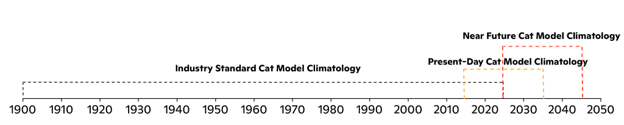
But insurers in the U.S., by and large, use the model versions that assume stationarity from 1900 to today. Ian Gray, a professor at Johns Hopkins University, brilliantly recounts how this came to be in his 2021 paper, Hazardous simulations: Pricing climate risk in US coastal insurance markets.[3] When modelers publicized their new warm sea surface temperature models in 2005, in some cases showing up to a 40% increase in losses compared to the standard model version, regulators, politicians, and consumer advocates pushed back. All modelers shortly reverted back to using the standard long-term view of hurricane risk except for Moody’s RMS. They maintained that their model was a scientifically sound adjustment in catastrophe modeling that built on recent advancements in understanding of decadal cycles and long term climate trends. After an intense and highly public battle, Moody’s RMS withdrew their model from consideration for approval by the Florida Commission on Hazard Loss Projection Methodology (FCHLPM) in 2007 after several contentious meetings with the commission. Any model that insurers want to use for pricing premiums in Florida must be approved by the FCHLPM. No model, except for Karen Clark & Company’s (KCC), has any explicit accounting for climate change in the Florida filings. Even then, KCC’s climate change-adjusted model produces fewer major hurricanes (i.e., Category 3 or higher) than the historical record.[4] Verisk[5] has even stated it is not clear whether the current state of warm sea surface temperatures is due to climate change.
The FCHLPM rejecting climate change-aware models has implications beyond Florida. States across the Gulf and Atlantic coastline look for the FCHLPM stamp of approval when reviewing models for use in their own states. South Carolina even outlawed the use of models that represent present-day sea surface temperatures. All but one insurance company in Louisiana uses the long term, 1900 to present day, hurricane model for rate calculations despite being allowed to use the warm sea surface temperature model versions.[6]
This dichotomy between the models U.S. insurers use and the models reinsurers and global investors use is one side of the story. The other is the cyclical nature of disasters. That is, the natural variability of the climate system. A spike in reinsurance pricing occurred in 1993 after Hurricane Andrew devastated South Florida, in 2006 following the harrowing hurricane seasons of the two prior years that saw Hurricanes Wilma and Katrina, and starting in 2018, after four hurricanes made landfall, including Hurricane Harvey which inundated Houston, through several costly hurricane seasons and severe convective storm events culminating in 2025 with the Los Angeles wildfires. Following heavy investor and reinsurer losses, markets react and the appetite for risk falls temporarily. The risk itself hasn’t changed over a five year period, just how we perceive it.
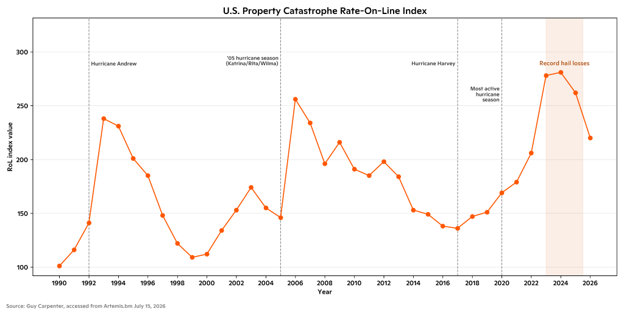
Risk transfer is a driving force behind the increase in premiums across the country. Insurers no longer solely decide the cost of insurance for a home because they are bound by the price investors are willing to pay for taking on the tail risk of those insurers. As the price signal trickles down from capital markets to the neighborhood insurance agent, premiums rise. In 2024, reinsurance pricing could be attributed to 45% of the increase in insurance premiums.[7] And the impact is not equal across the country. Disaster-prone areas have seen the greatest increase in premiums. In 2014, highest-risk areas paid 30% higher premiums than lowest-risk areas. By 2024, the gap widened to 53%. This is because losses in high risk areas are strongly correlated. Insurers are not willing to gamble becoming insolvent due to a bad storm impacting a large number of their policyholders so they purchase reinsurance to hedge that risk.
Fluctuations in reinsurance pricing can be mitigated by only so much – capital markets are beholden to short term returns. But as insurers start to offload[8] more and more risk to global investors, the premiums people pay will become increasingly influenced by what capital markets charge for buying that risk. In 2022, foreign companies, which are not subject to U.S. state-level insurance regulations, made up almost two-thirds[9] of the total U.S. reinsurance market. When U.S. insurers and foreign investors use fundamentally different assumptions about the climate in their models, the policyholder pays the difference.
This ultimately impacts allocators in two main ways. One is conducting due diligence on insurance-linked securities and what climatology their respective catastrophe model(s) uses for pricing. The other is moving capital towards climate risk-aware investments. Not only does this protect assets but lowers premiums and helps maintain a stable insurance market, thereby increasing profitability of insurance-linked securities.
Studies[10] have shown that hurricanes are now able to deliver more damage than before through an increase in wind speeds, higher rainfall rates, and slower translation speeds. Inflation-adjusted disaster data shows a clear upward trend in damages over the last 45 years.[11] Climate change is impacting almost every peril covered by insurance: wildfires[12] are getting more intense, sea levels[13] are rising, extreme rainfall[14] has become more frequent, and there is even evidence hail[15] will become more destructive with future warming. The risk landscape is changing – our models and regulations need to keep up.
What this means for investors
Investors already adopt, by default, a warmer view of hurricane risk than most U.S. primary insurers, so the gap between the two views is not by itself a sign that bonds are mispriced. The risk is that even the warmer view from present-day models could be too low, as they reflect, in part, conditions from the past decade that have fundamentally shifted since. With multiples investors are seeing today, there is less cushion if that turns out to be true. Near future climatology presents an opportunity to better price risk as climatic conditions shift more quickly.
Here are a couple questions to ask your managers:
- What time period do your risk estimates reflect? Everything since 1900, the last decade or so, or a look ahead? Can you show how your biggest holdings change for each set of assumptions?
- When insurers price their policies on one view of hurricane risk and buy protection on another, someone pays the difference. Today that is mostly passed on to policyholders. If insurers have to move to a warmer, forward-looking view, what might change for me as an investor?
If it would help to talk through how climate science bears on the models you rely on, we are glad to speak. Reach out to us at Woodwell Climate Research Center.
[1] Artemis.bm. As cat bond loss multiples tighten, AM Best urges investors towards greater selectivity. September 25, 2026. https://www.artemis.bm/news/as-cat-bond-loss-multiples-tighten-am-best-urges-investors-towards-greater-selectivity/.
[2] Federal Reserve. Economic Well-Being of U.S. Households in 2024. May 2025. https://www.federalreserve.gov/publications/files/2024-report-economic-well-being-us-households-202505.pdf.
[3] Gray, Ian. “Hazardous simulations: Pricing climate risk in US coastal insurance markets.” Economy and society 50.2 (2021): 196-223.
[4] This indicates the climate signal is trivial and has little to no impact on the model output.
[5] Verisk. Issue Brief: Weathering Hurricane Variability in a Warm Atlantic. 2018. https://risksolutions.verisk.com/49934b/siteassets/Publications/White-Papers/documents/Issue-Brief–Weathering-Hurricane-Variability-in-a-Warm-Atlantic.
[6] Based on an internal Woodwell Climate Research Center review of public Louisiana Department of Insurance homeowners rate filings. Some insurers, such as Progressive and Liberty Mutual, file their catastrophe model usage as confidential.
[7] Keys, Benjamin J., and Philip Mulder. Property insurance and disaster risk: New evidence from mortgage escrow data. No. w32579. National Bureau of Economic Research, 2024.
[8] Atlas Magazine. The U.S reinsurance market dominated by foreign companies. June 5, 2023. https://www.atlas-mag.net/en/articles/us-reinsurance-market-dominated-foreign-companies-0.
[9] Reinsurance Association of America. Offshore Reinsurance in the U.S. Market: 2022 Data. 2023. https://www.reinsurance.org/RAA/RAA/Analytics/Offshore-Report/Offshore%20Report.aspx.
[10] Camargo, Suzana J., et al. “An update on the influence of natural climate variability and anthropogenic climate change on tropical cyclones.” Tropical Cyclone Research and Review 12.3 (2023): 216-239.
[11] Munich RE. Natural disasters worldwide: Losses are on the rise as climate change strikes. April 2026. https://www.munichre.com/en/risks/natural-disasters.html.
[12] Cunningham, Calum X., Grant J. Williamson, and David MJS Bowman. “Increasing frequency and intensity of the most extreme wildfires on Earth.” Nature ecology & evolution 8.8 (2024): 1420-1425.
[13] Nicholls, Robert J., and Anny Cazenave. “Sea-level rise and its impact on coastal zones.” science 328.5985 (2010): 1517-1520.
[14] Robinson, Alexander, et al. “Increasing heat and rainfall extremes now far outside the historical climate.” NPJ Climate and Atmospheric Science 4.1 (2021): 45.
[15] Gensini, Vittorio A., et al. “Hailstone size dichotomy in a warming climate.” npj Climate and Atmospheric Science 7.1 (2024): 185.