
By Aaron Filbeck, CFA, CAIA, CFP®, CIPM, FDP, Managing Director, Content & Community Strategy, CAIA Association
Christopher Nolan’s adaptation of The Odyssey has prompted renewed interest in one of literature’s oldest stories. In it, Odysseus spends the entire epic trying to get to one fixed point: home, to see his wife and son in Ithaca. Everything else, the cyclops, the sirens, seven years stranded with Calypso, serves as a distraction, a setback, or friction between him and getting to that point.
The Independent ran a piece this summer tied to the release, built around a clinical psychologist’s read on the story.[1] A colleague sent it to me for an unrelated reason, but one point really stuck with me on a personal level: if you don’t define your own “Ithaca” clearly, you risk getting pulled toward someone else’s version of what your life should look like. I think the same idea applies professionally. Markets, careers, and industries all have a way of rewarding motion. They don’t always reward direction.
Odysseus doesn’t make it home because he’s the strongest character in the story but rather because he never loses track of where he’s headed, even when the detour looks better than the destination.
In that sense, The Odyssey is really a story about time. Every distraction carries a cost, and every unnecessary detour consumes a resource that can never be recovered. If Ithaca is your true north, then time is the currency you spend getting there. Sadly, that horizon is shrinking around us all.
Short-term Thinking Is the Trojan Horse
FCLTGlobal has tracked corporate and investor investment horizons since 2009 through its FCLTCompass project.[2] The average public company investment horizon has gone from six years, six months in 2009 to five years, three months in 2024, a 19 percent decline. Horizons drifted down through the 2010s, ticked up briefly in 2020, fell again through 2021 and 2022, recovered slightly in 2023, then fell again in 2024 to the lowest point since FCLTGlobal started tracking.
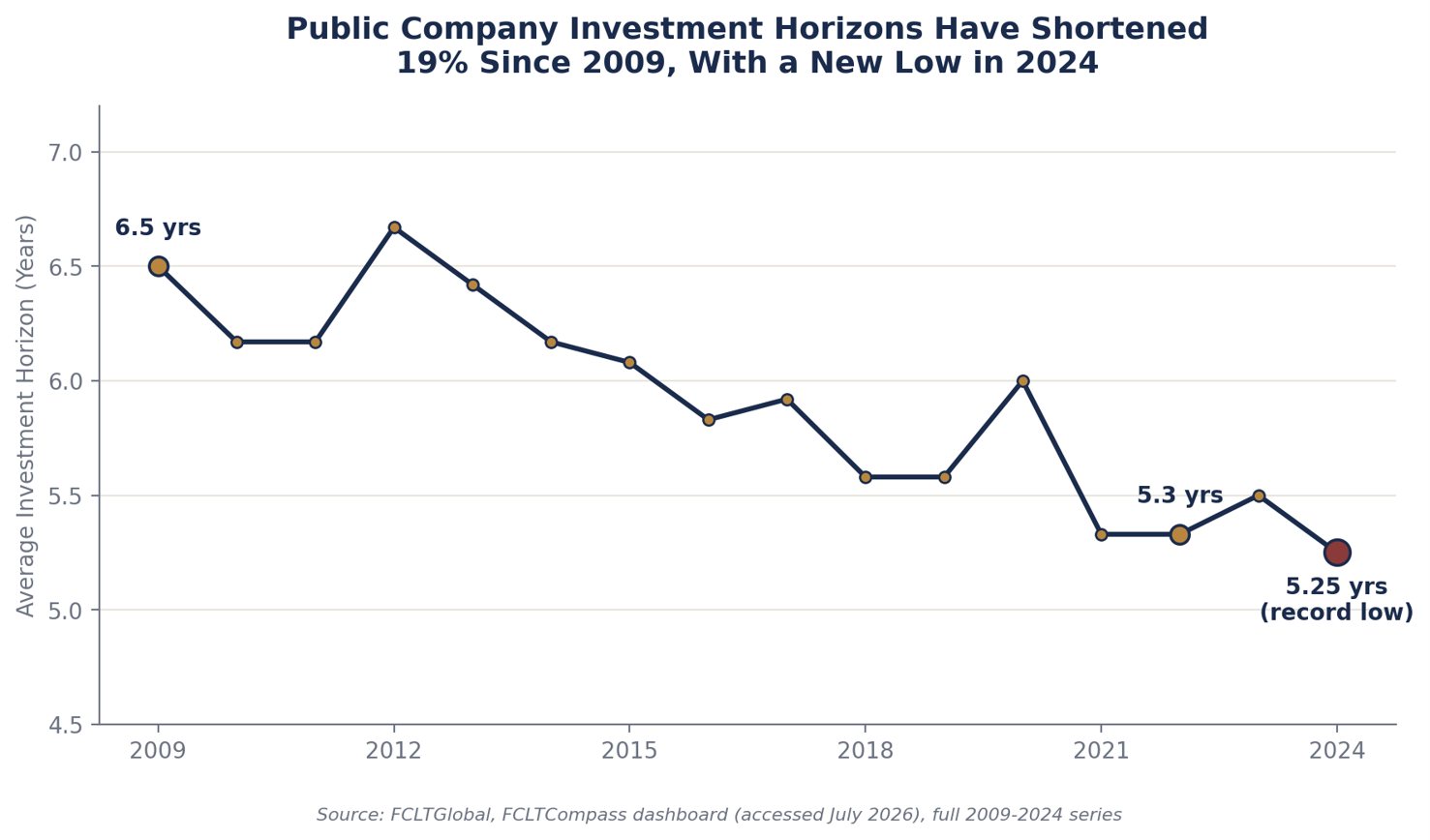
Figure 1: Public Company Investment Horizons, 2009-2024
Source: FCLTGlobal, FCLTCompass, Author’s Estimations and visual created by Claude
However, companies aren’t necessarily shortening their horizons because they’re under financial pressure. In 2024, corporate valuations hit record highs and profits stayed strong.[3] Companies are choosing flexibility over commitment anyway, holding more cash and returning capital to shareholders through dividends and buybacks, which grew 9 percent year-over-year to historic levels, rather than reinvesting for the long term. In a world of options, optionality is seductive.
In a 2013 global survey run by McKinsey and the Canada Pension Plan Investment Board, covering more than a thousand board members and C-suite executives, 63 percent said pressure to deliver short-term results had gotten worse over the prior five years, and 79 percent said they felt pressure to show strong financial performance within two years or less. 86 percent believed a longer horizon would improve performance, including innovation, and 73 percent said they should be using a horizon of more than three years. Unfortunately, only 44 percent actually did.[4]
McKinsey and FCLTGlobal went back to the question in 2020, surveying 481 executives at the director level or above. Nothing changed directionally, showing up in different ways. Respondents were asked what their companies would do if revenue dropped 15 percent for reasons that were explicitly temporary and posed no real threat to the business, something like a currency swing. On average, they said they’d still cut long-term growth investment by 17 percent.[5]
In other words, most leaders know the short game is probably hurting them, but they play it anyway. McKinsey’s Corporate Horizon Index, which scores individual firms on how long-term their capital decisions are, found that companies on the long end of the spectrum outperform the short-term ones by a wide margin, not just on returns but on job creation.[6] Long-term orientation is a measurable edge most organizations are simply choosing not to take.
Why might this be the case? A 2022 study in Strategy Science found that firms shorten their own investment horizons after watching shareholders sue their peers, a contagion effect where legal risk to somebody else still makes you play defense.[7] Separate research out of the EU found that public companies locked into quarterly reporting cycles see weaker long-term market value than companies that aren’t bound to the same ninety-day scoreboard.[8] A company reporting every quarter starts optimizing for the next quarterly release… instead of the next decade.
None of this is an argument for ignoring near-term numbers. After all, Odysseus still had to get out of the cyclops’ cave before he could think about Ithaca at all. Short-term execution matters, but only if the near term supports the long term.
Choppy Waters Around Us
EY’s Megatrends 2026 report describes the current landscape as nonlinear, accelerated, volatile, and interconnected, and argues the old approach of tracking one trend at a time doesn’t work anymore because technology, geopolitics, sustainability, and demographics are now colliding rather than moving on separate tracks.[9] Frost & Sullivan’s 2026 megatrends research makes a similar point: trade fragmentation, workforce transformation, and climate adaptation are actively compressing planning cycles.[10] A signal you’d normally have a year to act on now gives you a quarter.
Global X’s research on technology adoption backs this up too. Each new technology wave reaches scale faster than the one before it. What used to take decades to move from lab to mainstream now takes years.[11] In other words, acceleration is accelerating, which is harder to plan around because the growth itself is non-linear.
Sitra, Finland’s public innovation fund, framed its own 2026 megatrends work around the same idea: it feels like one disruption barely eases before the next is already at the door, fast-moving and slow-burning crises tangled together to the point where it’s hard to tell where you stand today, let alone where you’re headed.[12]
Put the two trends together, shorter horizons on the inside and faster currents on the outside, and you get a true and modern siren song. Doing something in the short term feels good in the moment, but you may just be jumping off the boat to your demise.
Sometimes The Destination Is As Important As The Journey
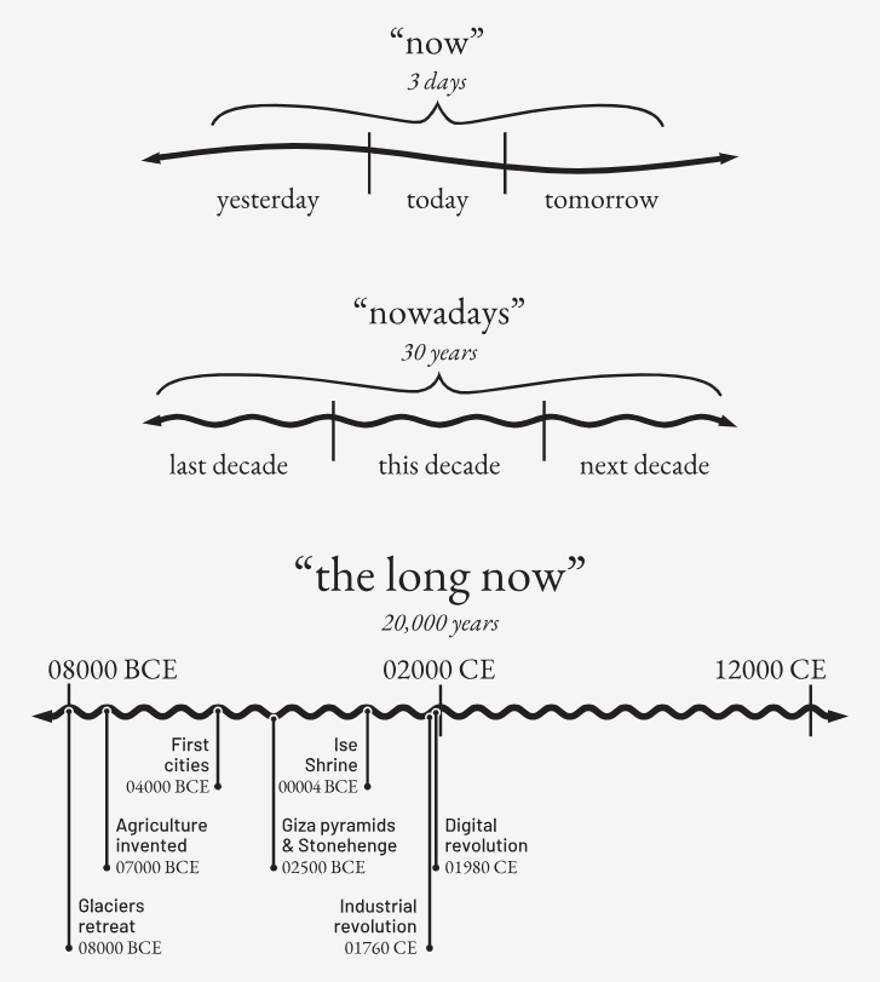
Figure 2: The Long Now vs. Now vs. Nowadays
Source: The Long Now Foundation
The Long Now Foundation, a nonprofit building a mechanical clock designed to keep time for 10,000 years, has spent almost thirty years arguing the opposite case. Brian Eno, who named the organization, described the project as an attempt to pull people out of what he called the “short now” of next quarter, next week, or next five minutes, and into a longer sense of time stretching in both directions, past the length of a single career or a single company.[13]
You don’t need a ten-thousand-year clock to use the idea. You need a true north, the way Odysseus could name Ithaca, and the discipline to check your position against it instead of against the noise coming in from every direction.
Odysseus wasn’t tempted because he was weak. He was tempted because every distraction along the way, Calypso’s island, the lotus eaters, even the sirens, met a real need in the moment, but eventually got back on track.
Nobody blows up a long-term strategy in one decision. It erodes one quarter, one reactive pivot, one “everyone else is doing this” moment at a time, until you look up and realize you’ve been circling the same island for a year.
Steering the Ship
If you’re running a team, a firm, a portfolio, or your own career, the pressure to shorten your horizon isn’t going away. It’s probably already happening to you, and you have to fight it. So, the question isn’t whether the currents will try to pull you off course.
They probably will.
The question is whether you’re convicted enough in your strategy, your plan, your portfolio, and your direction to recognize a distraction dressed as an emergency when it shows up, and to have something solid to check it against. I’m always a fan of the whiteboard and asking myself, “if we blank slated this today…would we do it the same?”
Odysseus took ten years to get home. He didn’t get there by moving faster than everyone else. He got there by refusing to forget where home was. In a world where the planning horizon keeps shrinking and the pace of change keeps compressing, that might be the more useful lesson. Resilience and grit are necessary in this business, but so is knowing your fixed point. Check your position against it often and let the rest be background noise.
[1]Akbar, S. The Odyssey Mindset (Bluebird, 2026), as excerpted and discussed in The Independent, “The Odyssey Mindset: Odysseus, resilience, and finding your true north,” 2026. https://www.the-independent.com/life-style/odyssey-mindset-odysseus-resilience-b3015100.html
[2]FCLTGlobal, FCLTCompass dashboard and 2025 Report (“Near-Term Flexibility for Long-Term Value”), data through 12/31/2024, fcltglobal.org/fcltcompass. Note: FCLTGlobal revises prior years’ figures as underlying index constituents are restated, so the 2022 figure shown here (5.33 years) differs slightly from the “five years even” originally published in FCLTGlobal’s 2023 report.
[3]Ibid.
[4]McKinsey Quarterly and the Canada Pension Plan Investment Board, global survey of more than 1,000 board members and C-suite executives, 2013. As cited in “Investing for the Long Term,” McKinsey & Company, and “Long-Termism Versus Short-Termism: Time for the Pendulum to Shift?,” Institutional Investor.
[5]FCLTGlobal and McKinsey & Company, “Corporate Long-Term Behaviors: How CEOs and Boards Drive Sustained Value Creation,” 2020, based on a survey of 481 director-level and above executives fielded June-July 2020.
[6]McKinsey Global Institute, McKinsey Strategy & Corporate Finance, and FCLTGlobal, “Measuring the Economic Impact of Short-Termism,” 2017, discussed in “The Case Against Corporate Short-Termism,” Milken Institute Review.
[7]Strategy Science, “Why Are Corporate Investment Horizons Shrinking? Uncovering the Spillover Effects of Shareholder Litigation,” 2022.
[8]Journal of Risk and Financial Management (MDPI), “Does Short-Termism Influence the Market Value of Companies? Evidence from EU Countries,” 2020.
[9]EY, “Megatrends 2026 and Beyond,” ey.com.
[10]Frost & Sullivan, “Global Megatrends 2026: Forces Redefining Growth, Risk, and Strategy,” 2026.
[11]Global X ETFs, “Charting Disruption: Outlook for 2026 and Beyond.”
[12]Sitra, “Megatrends 2026,” sitra.fi.
[13]The Long Now Foundation, https://longnow.org/ideas/the-big-here-and-long-now/