
By Stuart Eliot, General Manager, Investments, AMP, Jonas Benner, Senior Quantitative Researcher, AMP, and Patrick Kazley, CEO, One River Asset Management
Introduction
Last year when Jonas and I[1] began writing about Store of Value assets we had no idea that we would end up reconsidering the defensive sleeve within a multi asset portfolio. At the time, we were simply trying to understand the role these assets might play in preserving purchasing power and protecting long-term wealth.
One question led to another, eventually forcing us to confront a more fundamental issue: what happens if government bonds are no longer able to reliably perform the role investors expect them to do? What if instead they transform into headwinds during turbulent times (i.e., inflationary crises, prolonged debasement to solve nominal debt issues)?
Where this thought experiment lead was surprising and has begun to influence how we manage our clients’ savings. We came to believe that investors need to diversify their diversifiers.
As we were finalising that framework, conversations with Patrick Kazley from One River Asset Management revealed something fascinating. We were approaching the same problem from different directions and arriving at remarkably similar conclusions.
One River’s latest paper, The Perfect Hedge, addresses a question that appears simple until fully considered: what should a hedge actually do, and how should it be constructed? The answer led us realise to that the future of portfolio construction lies less in finding a better defensive asset, and more in building a better defensive system.
The Problem Isn’t Bonds
That’s not to say that bonds don’t have a problem – but it’s certainly plausible they have a more difficult path ahead given the starting point of the global monetary system. For example, it’s hard to see a path back to fiscal responsibility when politicians occasionally speak the truth:
“We all know what to do, but we don’t know how to get re-elected once we have done it.”
– Jean-Claude Juncker (former Prime Minister of Luxembourg and President of the European Commission)
The US has accumulated more gross federal debt relative to GDP than during World War II
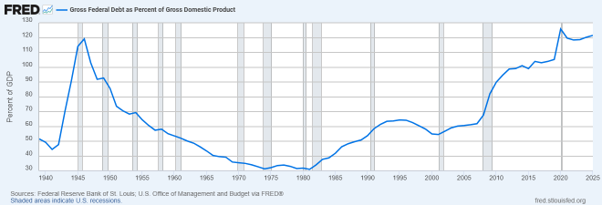
Our original concern in writing Alternative Diversifiers was trying to find a solution to the problem that bonds may no longer provide reliable diversification. One River’s series of papers ask us to approach the problem from a different direction.
We had been searching for a better diversifier. One River was asking a deeper question: is it reasonable to expect any single asset or strategy to protect a portfolio from every form of market stress?
Probably not.
Sudden crashes, prolonged bear markets, inflation shocks, V-shaped reversals, policy mistakes and monetary debasement are fundamentally different problems. Expecting a single asset or trading strategy to defend against all of them is unlikely to succeed.
Defence Has Layers
The central idea in The Perfect Hedge is that defensive assets should be categorised by what they do rather than what they are.
Most investors think of diversification in terms of asset classes. Equities, bonds, alternatives, etc. The implicit assumption is that if we populate enough boxes then diversification has been achieved.
But market stress can take on many distinct forms.
Some crises arrive suddenly. The 1987 crash, the COVID sell-off and the collapse of Long-Term Capital Management were characterised by speed and disorder. Investors needed immediate protection.
Other drawdowns unfold gradually. The bursting of the technology bubble, the inflation-driven bear market of 2022 and many historical recessions developed over months rather than days: investors needed persistence rather than immediacy.
Other periods can be chaotic declines but shallow (e.g., August 2015, February 2018) or fully recover faster than they set in (e.g., April 2025, August 2024).
A single defensive asset or defensive strategy is unlikely to excel in all environments.
One River’s Ingredients Across Various Challenging Equity Environments
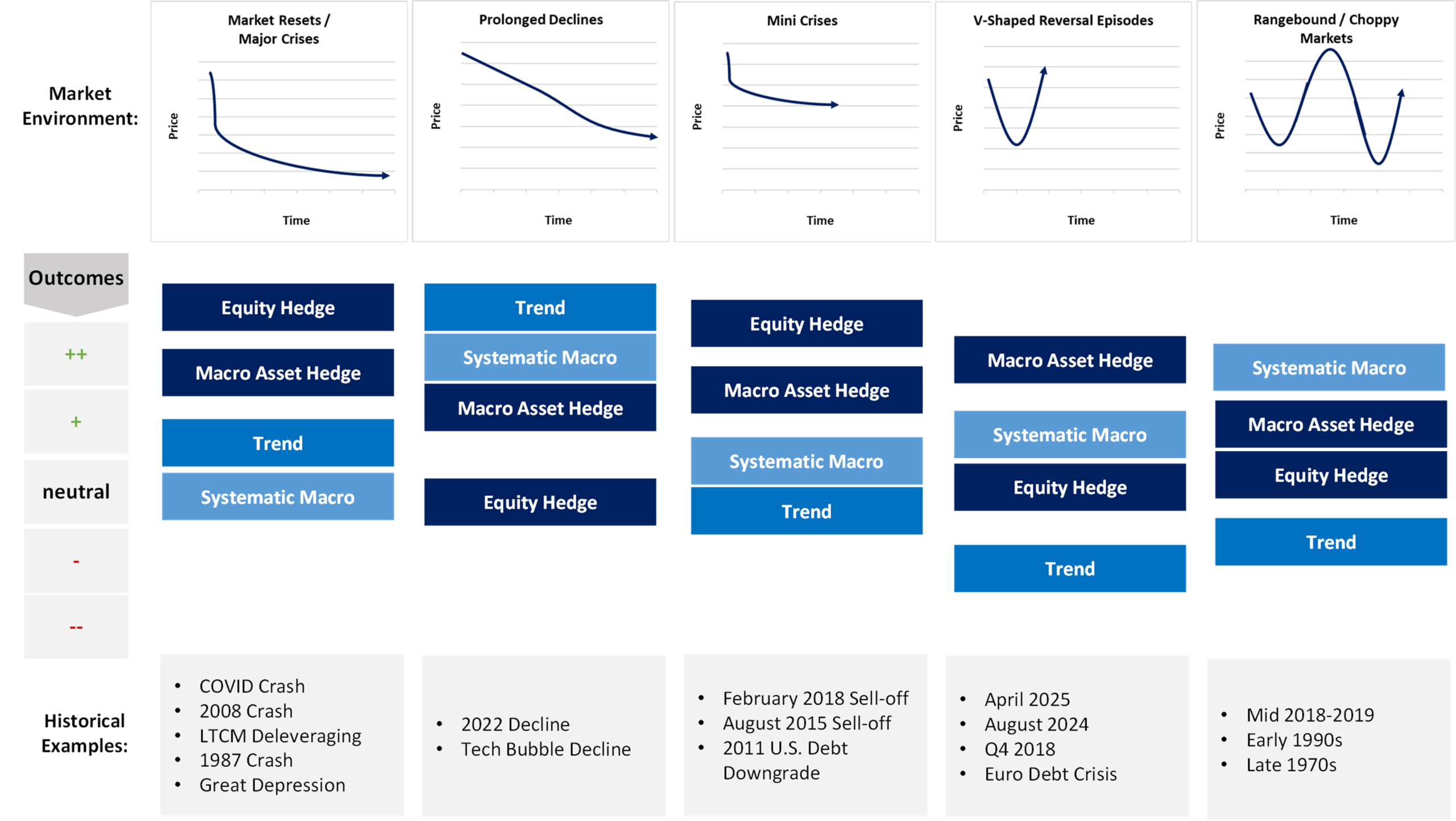
Source: One River. For illustrative purposes only. Source: One River. Past performance does not guarantee future results.
This observation led One River to separate risk mitigation strategies into three distinct categories: First Responders, Second Responders, and Diversifiers.
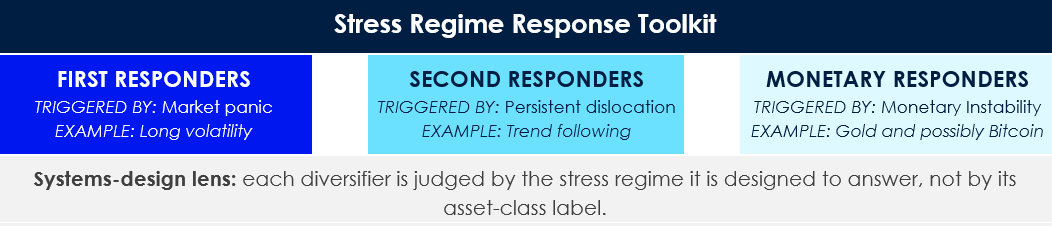
- First Responders are the portfolio’s fast-twitch muscles. Their job is to respond immediately when markets become disorderly. Long volatility strategies sit in this category. They are designed to provide explicit and reliable protection during sudden market declines, even if that protection comes at the cost of carrying them during quieter periods.
- Second Responders are the portfolio’s slow-twitch muscles and are intended to complement the First Responders. Rather than reacting to sudden panic, they seek to identify and exploit persistent trends as they emerge. Trend-following strategies are often less effective in the opening stages of a crisis but become increasingly valuable as market dislocations deepen and trends become established.
- Diversifiers are capital-efficient, liquid alpha strategies whose job is to lift the average return of a risk mitigation program without importing short volatility or negative skew into a portfolio that benefits from the opposite. They matter for the longevity of a program, but they are deliberately optional and not explicitly defensive.
Our focus here is on the two Responder categories, because it is the explicitly defensive layer of the system where we believe something may be missing.
One River’s Risk Mitigation Solutions Framework
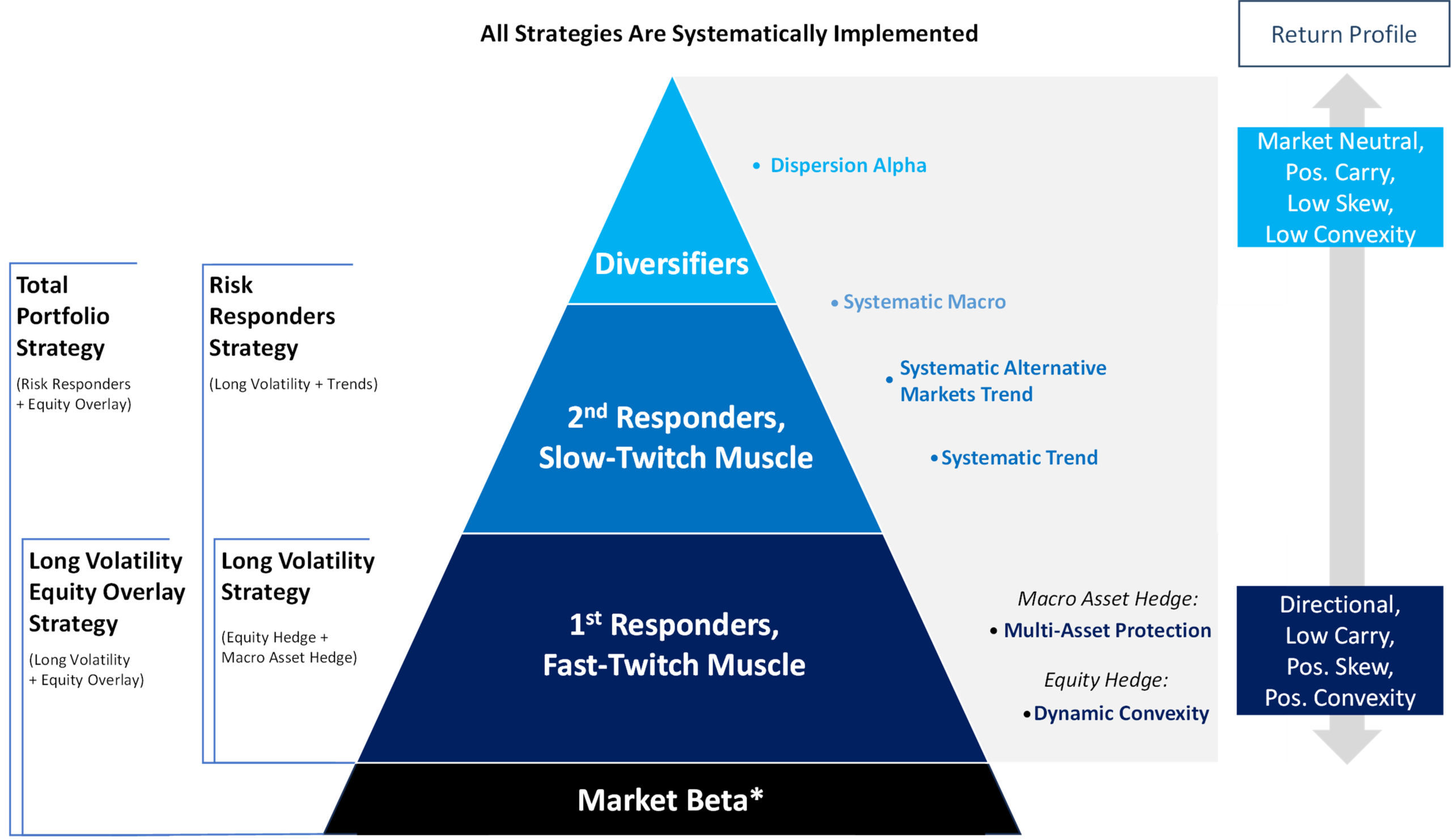
Source: One River. For illustrative purposes only. Source: One River. Past performance does not guarantee future results.
Is There a Third Responder?
We agreed with One River’s distinction between First Responders and Second Responders. Long volatility is designed to respond when markets become chaotic. Trend following is designed to respond when market dislocations become persistent. Together they create a powerful defensive framework.
But we found ourselves returning to a different set of questions:
- What happens if the problem isn’t a crisis that’s taking place in financial markets?
- What happens if the problem is the money itself?
Many of the challenges facing investors today do not fit neatly into the categories of sudden crashes or prolonged drawdowns. Persistent fiscal deficits, rising government debt burdens, financial repression and monetary debasement are slow-moving structural forces that can erode, indeed have been eroding, purchasing power over years.
In that environment, what is the appropriate response?
Neither long volatility nor trend following were explicitly designed to solve that problem. This led us to wonder whether there might be a third category with which we could enhance the framework.
We call them Monetary Responders.
Like First Responders and Second Responders, Monetary Responders have a specific role within the defensive system which is to protect against the loss of purchasing power that can occur when confidence in traditional monetary systems begins to weaken.
Monetary instability usually doesn’t arrive with a headline. Confidence in money erodes slowly. Fiscal deficits widen. Debt accumulates. Governments become increasingly reliant on inflation, financial repression or monetary expansion. By the time investors recognise what is happening, the process may already be well underway.
That creates a challenge for traditional risk mitigation strategies, which is why we believe store of value assets deserve consideration as a separate responder category to hedge monetary risk.
For centuries, gold[2] has fulfilled that role. It is scarce, globally recognised, and exists outside the liabilities of governments and financial institutions.
Cumulative Growth of $1 of S&P 500 vs. Gross Combination Portfolios (S&P 500 + Overlay), Log-Scaled April 1, 2015 – May 31, 2026
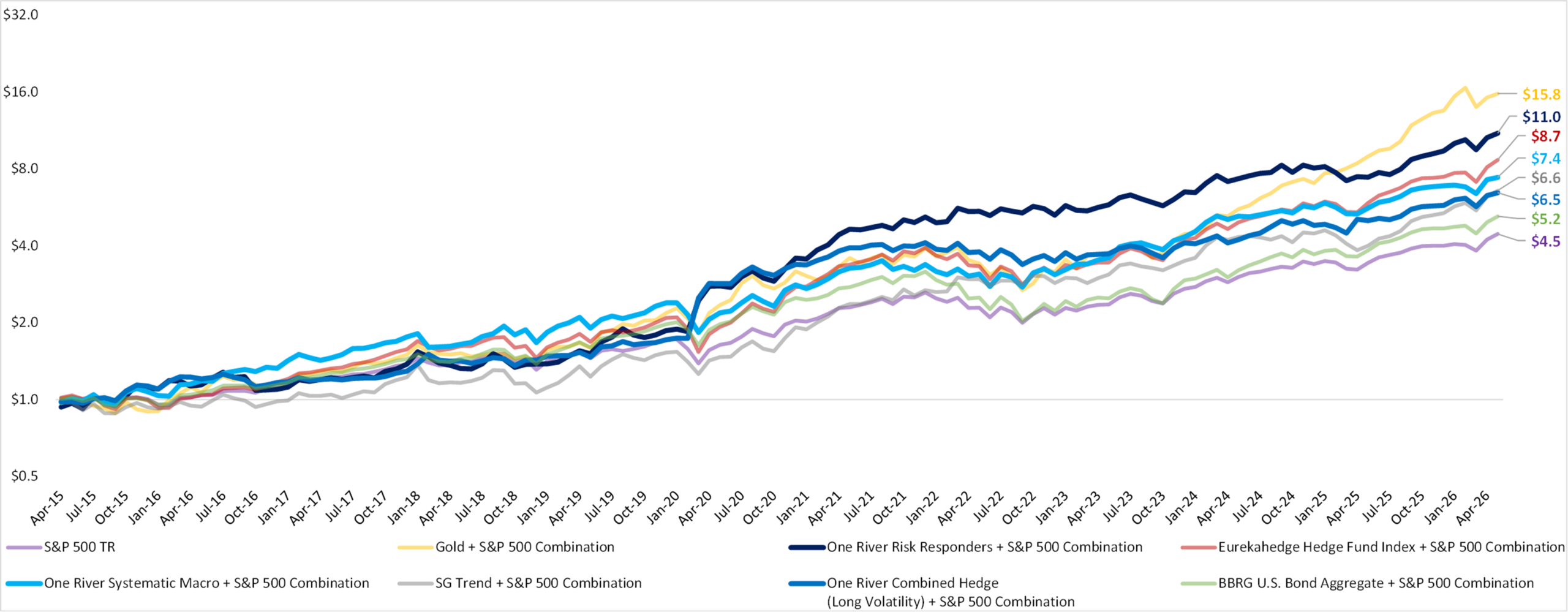
Source: One River, Bloomberg. The S&P 500 returns used are the S&P 500 Total Return Index. The Gold returns used are the SPDR Gold Shares ETF. U.S. Bonds returns used are the Bloomberg U.S. Aggregate Bond Index, Hedge Fund returns used are the Eurekahedge HF Index. The One River returns use live and live pro-forma gross returns. The pro-forma track records only use live returns, weighted and volatility-scaled in a static manner. The Risk Responders pro-forma is a combination of the Long Volatility and Trend pro-forma composites. The Combined Hedge (Long Volatility) Composite is a live pro-forma combination of modified Dynamic Convexity and Multi-Asset Protection strategies. The Systematic Macro portfolio reflects the performance of the LGT Risk Premia fund, achieved under a different legal entity and fund structure. Please see disclaimer. Gross performance shown. Net returns would be lower after management fees, expenses, and transaction costs. Past performance is not a guarantee of future results.
More recently, Bitcoin has emerged as a digital counterpart. While its history is far shorter and its path considerably more volatile, it shares the characteristics that have historically defined store of value assets: scarcity, durability, portability and independence from any single sovereign issuer.
To be clear, we are not suggesting that gold or Bitcoin are hedges in the traditional sense. They will not necessarily protect investors during a sudden equity sell-off. Nor should they be expected to behave like trend-following strategies during a prolonged bear market.
Their purpose is different. They are designed to respond to a different risk altogether.
Just as long volatility responds to market chaos and trend responds to persistence, store of value assets responds to monetary instability.
Seen through that lens, gold and Bitcoin are a natural extension of the One River framework.
From Asset Allocation to Systems Design
The most important conclusion is that investors may need to think differently about portfolio construction itself.
For decades, investors have organised portfolios around asset classes. Equities for growth. Bonds for defence. Alternatives for diversification.
That framework has served investors well. But it was built during a particular set of economic and political conditions. Investors should at least ask whether those conditions still exist.
The framework emerging from One River’s work and our own research starts from a different premise.

The answers matter more than the labels attached to the underlying assets.

This may sound like a subtle distinction. We think it is anything but.
And once viewed through that lens, the search for a perfect hedge begins to look misguided.
There Is No Perfect Hedge
The deeper we explored these ideas, the more we came to appreciate the wisdom of One River’s opening observation:
“Outside of a Japanese garden, there is no such thing as a perfect hedge.”
Portfolios face risks that come in all shapes and sizes. To search for a single asset or strategy capable of defending against all of them is to look for the wrong thing in the wrong place.
What One River’s framework demonstrates so effectively is that resilience emerges from combining different forms of defence. First Responders for the things that happen suddenly. Second Responders for the things that happen over longer periods.
Our contribution has been to suggest that a third category may belong alongside them: Monetary Responders.
Assets whose role is not to protect against market volatility, but against the gradual erosion of purchasing power and confidence in money itself.
Taken together, these ideas point towards a different way of thinking about portfolio construction: with the defensive sleeve as a coordinated system of responses rather than a collection of asset classes.
And in a future that will almost certainly surprise us, that distinction may prove to be the most valuable diversifier of all.
[1] For readability purposes this post is written from the perspective of Stuart Eliot, but the piece has been collaboratively informed by the listed co-authors.
[2] Within One River’s framework, gold also appears as a Macro Asset Hedge within the First Responders toolkit, which brings us to an important principle behind the classification of assets as responders: categories are defined by function, not by asset. Gold held tactically as a flight-to-safety hedge, sized and traded to respond to equity stress, is doing First Responder work. Gold held structurally, as protection against the slow erosion of confidence in money itself, is doing Monetary Responder work.