
Authored by Steve Novakovic, CAIA, CFA, Managing Director, Educational Programs
For the last several years, we’ve heard a great deal about the “democratization of alts” and the “convergence of public and privates.” In many ways, the rise of evergreens is the clearest expression of those trends, with private credit serving as the poster child. In 2020, retail exposure to private credit was so dwarfed by institutional exposure you had to squint to make it out. By mid-2026, retail exposure accounted for nearly half a trillion of the $2.5 trillion-plus private credit industry. According to Pitchbook data, private credit evergreen funds account for roughly $250 billion, a nearly 3x rise over the last four years.
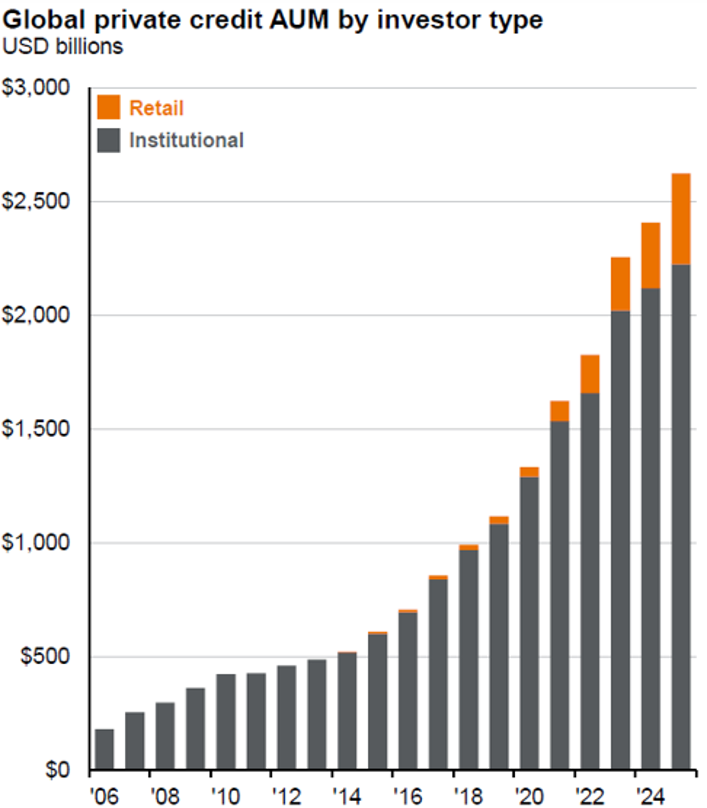
Source: JP Morgan
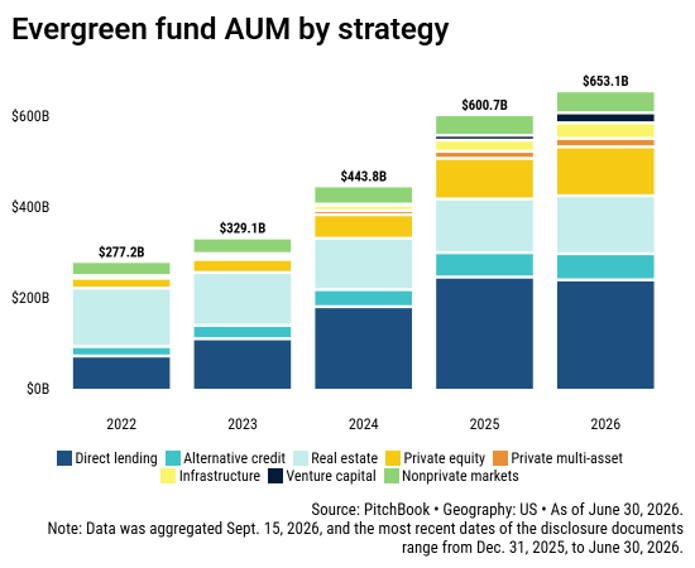
Source: Pitchbook
And despite the headlines, semi-liquid private credit funds have seen net inflows in each and every quarter through Q1 2026. Staying with private credit evergreen funds for a moment, the headlines over the last year would have you believe that the music has stopped and the party may soon be over. While it is true there have been several consecutive quarters of elevated redemption requests, and it is true there are credit concerns bubbling under the surface. The reality is that these most likely represent cyclical moments along the inevitable secular movement of democratization and convergence.
If anything, this cyclical down moment can be a further catalyst for the long-term secular winds. Let’s explore how.
One major concern emanating from the rapid rise of retail investment and growth of evergreen funds was the lack of education. A lack of education that ran the gamut from understanding the underlying strategy, the mechanics of the vehicle, and what tradeoffs and risks investors make by investing in the convergence of publics and privates. Did advisors and investors understand the risk of holding illiquid securities in “liquid” fund wrappers? Did advisors and investors understand what liquid really meant when investing in a semi-liquid fund? Did advisors and investors understand private markets investment strategies?
Advisors and clients may have said they understood, but for many, it takes touching a hot stove to truly understand what “do not touch” really means. These last three quarters investors and advisors alike got first-hand experience and a deeper understanding of what these vehicles are, and what these vehicles are not – the proverbial learning the hard way.
With this new-found knowledge, advisors should not only be better equipped to use evergreen funds but also feel emboldened to deploy them in portfolios where they had not been deployed previously. Why? According to JP Morgan, alts represent roughly 6% of portfolio exposure for high-net-worth investors and roughly 3% for the mass affluent. These numbers are a fraction of institutional investor exposures as well as the ultra-high net worth portfolios, which typically allocate a quarter or more of their portfolios in alts.
Further, in our conversations with advisors, we hear this low “average” allocation for retail investors is rather distorted. For some large advisors, 2/3rds of clients may have no exposure to alternatives in their portfolios. And that is the bigger picture. Not only is there room for allocations to grow, but there is a mass population with zero allocation. And for some, that zero allocation is absolutely the right choice. Alternatives and private market investments are not appropriate for every investor. For some, an allocation may benefit the portfolio by providing a diversified risk and return exposure not available via traditional stocks and bonds.
Returning to the hot stove analogy, what factors kept that large cohort of investors from getting too close to private markets? Again, from our conversations, a common refrain was education. As such, I am of the opinion that the advisory world just got a great education. And once the dust settles, they will be able to reflect on what they’ve learned and have greater confidence in using private market evergreen funds in client portfolios where appropriate for that client’s needs.
The other important education the advisors and investors received over the last three quarters pertains to the underlying strategies themselves. Based on the headlines, it would have been easy to believe that every private credit fund was going to suffer a mass wave of defaults as the rise in AI makes every legacy technology company obsolete.
And yes, private credit has meaningful exposure to technology. According to JP Morgan, nearly 40% of private credit deal value over the last five years went to technology companies, half of that to software companies.
This exposure and the rise of AI did introduce some stress into the system the private credit. Default rates rose from roughly 1% at the end of 2021 to a peak of over 2.5% at the end of 2025. However, the last two quarters have seen a modest downward trend. Another indicator that may be a better canary in the coal mine is distressed exchanges of leveraged loans. These rose from less than 1% in 2021 to nearly 5% in 2025, an alarming and dramatic rise. However, they have fallen back to 3%, nearing the 2% average seen pre-pandemic.
The reality is it is far too early to say exactly how AI will impact businesses. There will be winners, and there will be losers and defaults. But what is for sure about the reality is that not every private credit backed technology company will default on their loans, and private credit investors will not suffer catastrophic losses as a result of AI. And once again, this represents a great education for advisors and investors. A reminder that there can be moments of stress, and the vehicles operate as intended to protect investors from themselves. Rather than a mass wave of redemptions causing forced liquidations at fire sale prices, withdrawals were capped at their 5% limit, portfolio holdings were maintained, and, in general, performance persisted. Based on JP Morgan data, direct lending strategies generated an average return of 9.3% in 2025, and a 1.1% return in Q1 2026. Counter to what the headlines would lead one to believe.
In a missive filled with metaphors, I will conclude with one more. I don’t know which inning we are in. But when it comes to the rise of evergreens, I believe we are in the early innings. The secular trend isn’t going anywhere and now that we’re all a little bit more educated, it’s only going to keep on rising.