


By Laura Merlini, CAIA, CIFD, Managing Director, EMEA, CAIA Association
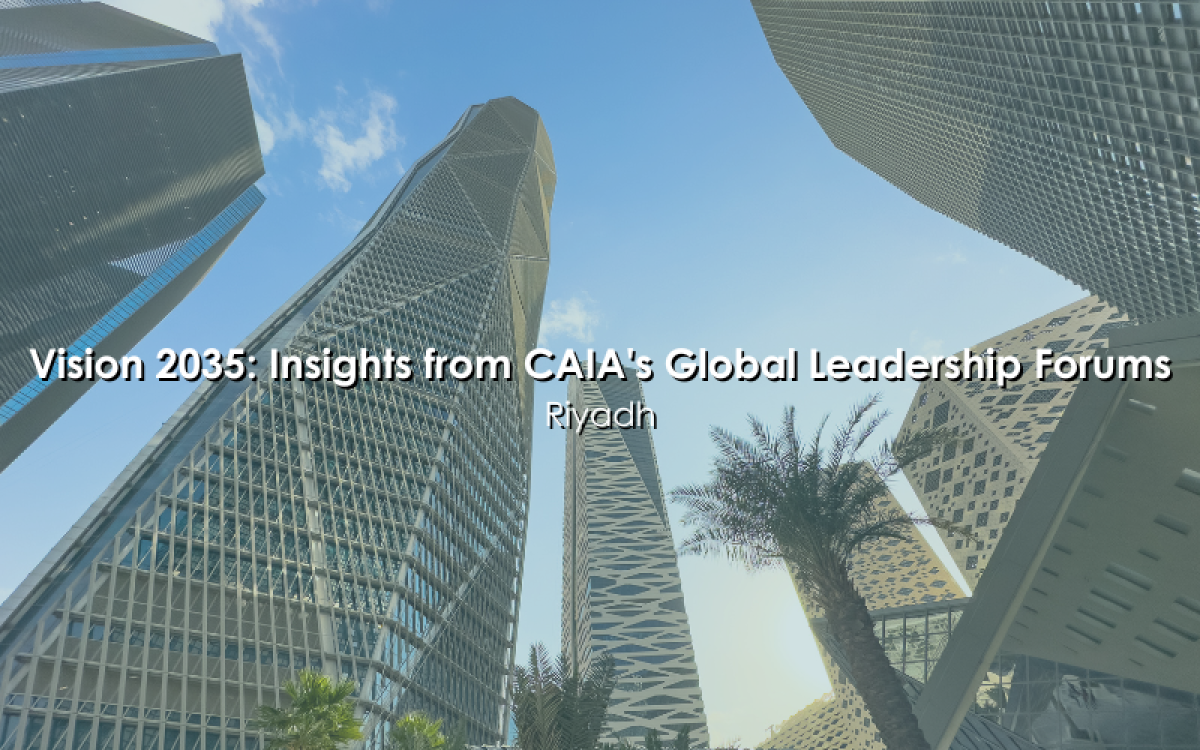
In traditional majlis gatherings, decisions were sealed over Saudi coffee and dates, built on personal relationships and trust developed over years. Honoring the same spirit, CAIA gathered senior investment professionals at the heart of King Abdullah Financial District for the final stop in our 2025 global roundtable series. After conversations in Los Angeles, Toronto, New York, London, Singapore, Hong Kong, and Mumbai, we arrived in the Kingdom to discuss what may be the most dynamic investment landscape we encountered all year.
What we found was a market at an inflection point. Extraordinary growth is colliding with structural gaps as their Vision 2030 ambitions meet ground-level realities and the future of the investment profession is being shaped in real time.
The Dual Mandate
A core challenge emerged repeatedly: how do you invest for national development while also delivering strong financial returns?
Saudi investors often operate under dual mandates. Investment strategies are expected to support national objectives such as job creation, local capacity building and economic diversification aligned with Vision 2030. At the same time, stakeholders expect competitive internal rates of return, disciplined risk management and credible exit pathways. This creates real tension. The Kingdom needs large-scale infrastructure and industrial development. But capital must still be deployed efficiently and accountably.
The prevailing view was not that investors must choose between impact and performance: success increasingly requires achieving both simultaneously.
Family Offices Evolution
The evolution of Saudi family offices illustrates how capital is changing in the Kingdom. Two decades ago investment decisions were typically centralized with family patriarchs who built operating businesses. Trust and long-standing relationships drove allocations. Today, the next generation is leading differently. CIOs with institutional experience sit alongside family principals, supported by asset allocation frameworks and more formal governance.
What has not changed is control. Families do not want to become passive allocators outsourcing decisions entirely to external managers. They want direct involvement, co-investment opportunities and transparency into underlying assets. As a result, Saudi family offices are diversifying beyond domestic real estate into global private markets. But they are not simply replicating Western portfolios. They are seeking investment strategies designed specifically for Saudi and regional opportunities. That is where the challenge emerges.
The Product Gap
Saudi investors consistently expressed demand for private market strategies deployed locally. Private credit, infrastructure and growth capital, aligned with domestic development priorities, featured prominently in discussions. What they are often offered instead are global strategies with minimal connection to the Kingdom.
Sharia compliance came up, but not as the barrier many might expect. It is a preference, not a dealbreaker. Alternative asset strategies can be structured to comply with Sharia principles. The real issue is customization. Saudi Arabia has one of the world’s largest Islamic finance ecosystems, historically estimated at around $800 billion in financial assets.
The financial infrastructure exists. What remains underdeveloped are alternative investment products specifically structured for local deployment and risk profiles.
Regulatory Momentum
The pace of regulatory development is one of the most striking aspects of the Saudi market. Over the past decade the Kingdom’s asset management industry has expanded rapidly. Total assets under management have grown from a relatively small base to more than SAR 1 trillion (approximately USD 265 billion) reflecting the maturation of the capital market.
The Capital Market Authority has played a central role in this transformation. Amendments to the Investment Funds Regulations and related frameworks, most recently approved in mid-2025, have modernized fund governance, expanded distribution channels and broadened permissible fund structures. These changes have materially improved the ease of launching and managing both public and private funds onshore.
Historically, private equity and alternative strategies were almost exclusively domiciled offshore. Today, a growing share of new funds are established directly under CMA oversight signaling increased confidence in the domestic regulatory framework.
Market infrastructure has developed alongside. The NOMU Parallel Market, launched in February 2017 as a lighter-regulation venue for growth companies, has expanded steadily from its initial listings. Real estate investment trust regulations were also introduced and scaled rapidly. Regulation is evolving in close alignment with market needs.
The Talent Challenge
Despite capital availability and regulatory progress nearly every discussion converged on talent. Labor market dynamics have shifted quickly. Where professionals once stayed with employers for five to ten years, younger talent now moves after one or two, often driven by salary increases of 30 to 40 percent. For early-career professionals these moves can be transformative.
The issue extends beyond retention. Only a small number of institutions in the Kingdom conduct large-scale sophisticated asset allocation. For specialized strategies, such as hedge funds or private credit, Saudi nationals with deep hands-on experience remain scarce. Part of this reflects economic history. Saudi Arabia compressed multiple stages of development into a short time frame, moving rapidly from a resource-based economy into a complex service and investment environment. Human capital development is still catching up with the pace of structural change.
AI and the Human Judgment
Artificial intelligence dominated conversations about the future workforce. But participants pushed back against simplistic narratives about AI replacing human judgment. Professional certifications still matter primarily because they signal discipline, rigor, and long-term commitment.
The more provocative point concerned AI’s limitations in investment decision-making. Large language models lack consistent logical reasoning and can express preferences that violate transitivity, a foundational principle of rational choice. They also appear to embed extremely high discount rates overweighting near-term outcomes in ways that diverge from how markets actually price risk.
The consensus was clear. Technical skills are now table stakes. What differentiates professionals is critical thinking judgment, curiosity and the ability to communicate complex ideas clearly.
The Pension Question
Beyond a few key entities Saudi Arabia lacks large sophisticated institutional asset owners. This emerged as perhaps the most significant structural challenge. The case for pension reform came through clearly. Capital markets require large institutional owners with long investment horizons. Saudi Arabia’s young demographics make this an ideal moment to establish fully funded pension accounts.
Today the existing system remains underinvested in local assets and carries meaningful currency risk through foreign holdings. Meaningful pension reform could deepen domestic equity markets and create the long-term institutional demand required for liquidity scale and market depth.
There is also a cultural dimension. The Kingdom has not historically had a strong savings culture, with citizens relying heavily on government support for retirement. That mindset is beginning to shift as part of Vision 2030 but institutional structures have yet to fully reflect this change.
Supply Chains Gaps
Significant efforts are underway to localize a large share of giga-project spending by building domestic supply chains. Capital is not the constraint. Interest from manufacturers and investors exists. What is missing is experience in structuring scaling and professionalizing businesses to meet large-project requirements.
Private equity firms with strong operational expertise and turnaround capabilities are well positioned to help bridge this gap. These firms bring the ability to professionalize businesses implement robust systems and scale operations efficiently.
A disconnect persists. Family offices and institutional investors are not yet systematically focused on acquiring local small and medium-sized enterprises, professionalizing them and forming joint ventures capable of supplying the Kingdom's major infrastructure projects.
The components all exist. Large-scale project demand is in place. Capital is abundant. Entrepreneurial businesses are operating locally. What is missing is the connective tissue: specialized fund managers who can bridge global best practices with local market realities while building durable supply chains.
The Opportunity
Global markets are fragmenting along regional lines and supply chains are being reorganized closer to end markets. Against this backdrop, Saudi Arabia checks nearly every box institutional investors prioritize: political stability, an increasingly clear regulatory framework, large-scale investable projects, abundant capital and strong long-term growth fundamentals.
At the same time sources of consistent alpha in developed markets are becoming increasingly scarce. In Saudi Arabia many inefficiencies remain unexploited. For asset managers willing to engage locally and structure strategies thoughtfully the opportunity set is compelling.
Interest rates have risen after a decade near zero while artificial intelligence reshapes business models and geopolitical tensions redefine trade flows. These forces are converging alongside Vision 2030's economic transformation, making Saudi Arabia one of the most consequential alternative investment laboratories in the world today.
What Comes Next
CAIA is expanding in the Gulf through new hires in Riyadh and Abu Dhabi, partnerships on Islamic finance education and Arabic-language content. Insights from this Riyadh roundtable will inform CAIA's Megatrends Report scheduled for release in March 2026.
The professionals gathered in King Abdullah Financial District are not replicating London or New York. They are building frameworks adapted to local realities while meeting global standards.
The task is complex and its successful execution will shape the Kingdom’s investment ecosystem for decades.
Interested in our insights on our 2035 Vision from around the globe? CAIA’s leadership team provides an exclusive peek into candid conversations that are shaping the future of investing. Check them out below!
Mumbai – Feb 2025 | Los Angeles – Mar 2025 | Toronto – Apr 2025 | New York – Jun 2025 | Board of Directors - Sep 2025 | London – Sep 2025 | Hong Kong – Oct 2025 | Singapore – Oct 2025 | Riyadh – Dec 2025
About the Contributor
Laura Merlini, CAIA, CIFD, is Managing Director, EMEA, for the CAIA Association since March 2012. She is a senior alternative investment professional with experience in strategic leadership, management skills and alternative investment knowledge in market outreach, brand development, reputation and member engagement. She formerly worked at Fortis Bank in Milan, Madrid, and Geneva. Since obtaining her CAIA Charter Certification in 2007, she has been an active member-volunteer, not only as the Co-founder of the CAIA Iberia Chapter in Madrid in 2008, but also as the Co-head of the CAIA Switzerland Chapter in Geneva as of 2010. Additionally, she chaired the 100 Women in Finance Educational Committee in Geneva between 2016 and 2018. Laura earned a BA in Business Administration at Bocconi University in Milan, received the CEMS MIM (Community of European Management Schools) MSc in International Management in 2002, and is a member of the Inaugural Class (2014) of the Executive Master in Positive Psychology, Leadership and Strategy from IE in Madrid. She strongly believes that governance is the core of a healthy financial industry, and this conviction led her to become a Certified Investment Fund Director accredited by the CIFD Institute in Ireland in 2015. Laura is also currently a member of the UN PRI HF Advisory Committee and a NED at Agave Advisors, an independent wealth manager firm based in Geneva. She is often invited to speak at conferences, roundtables and webinars on alternative investments. Having earned a Sommelier diploma, in her free time, she enjoys wine tasting as well as opera and art.
Learn more about CAIA Association and how to become part of a professional network that is shaping the future of investing, by visiting https://caia.org/